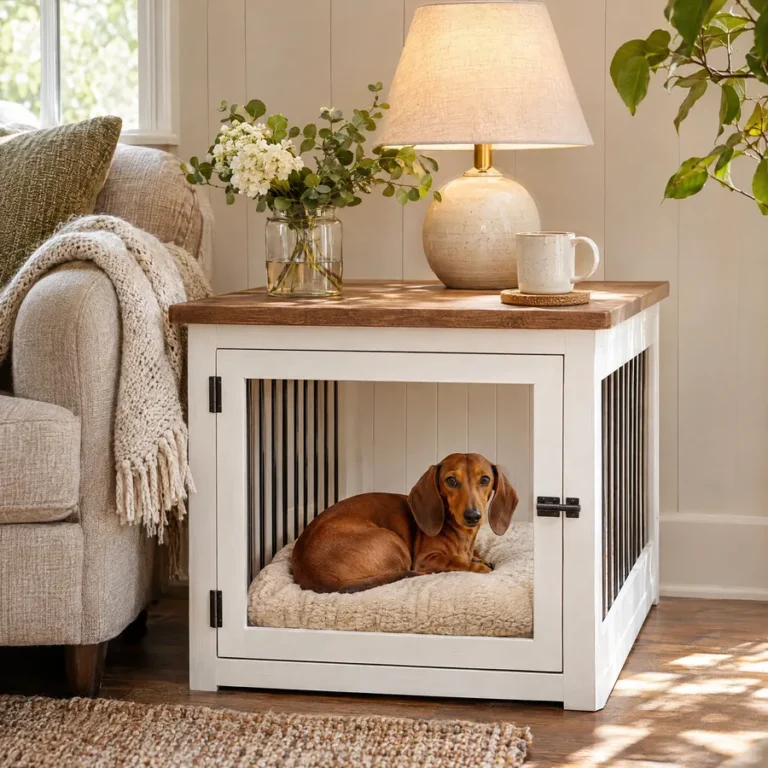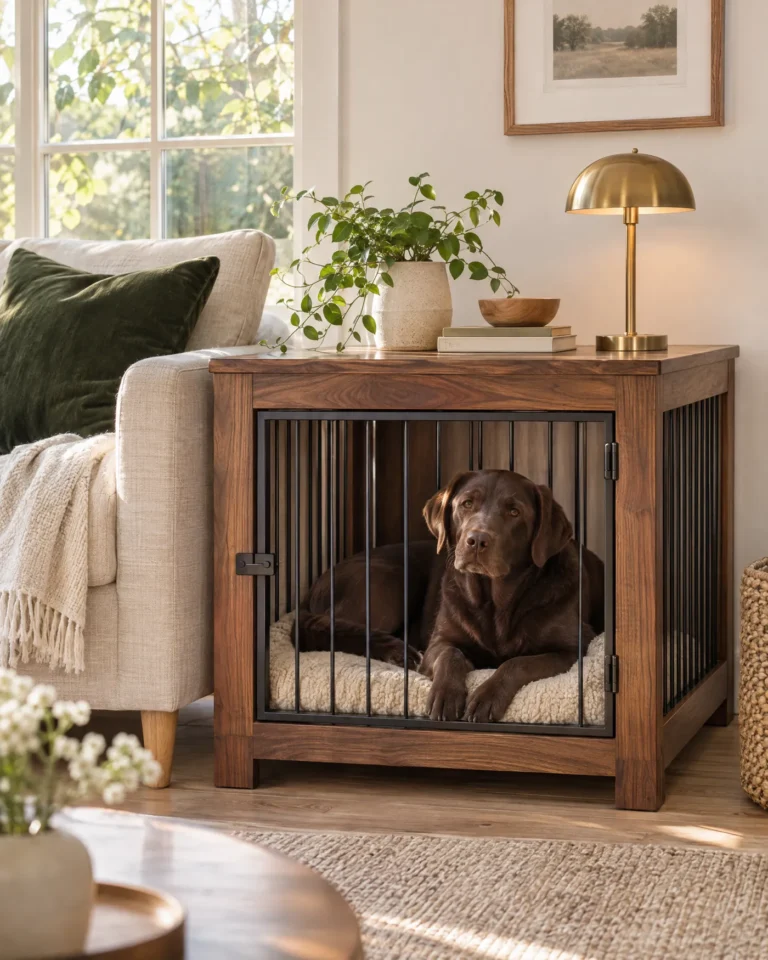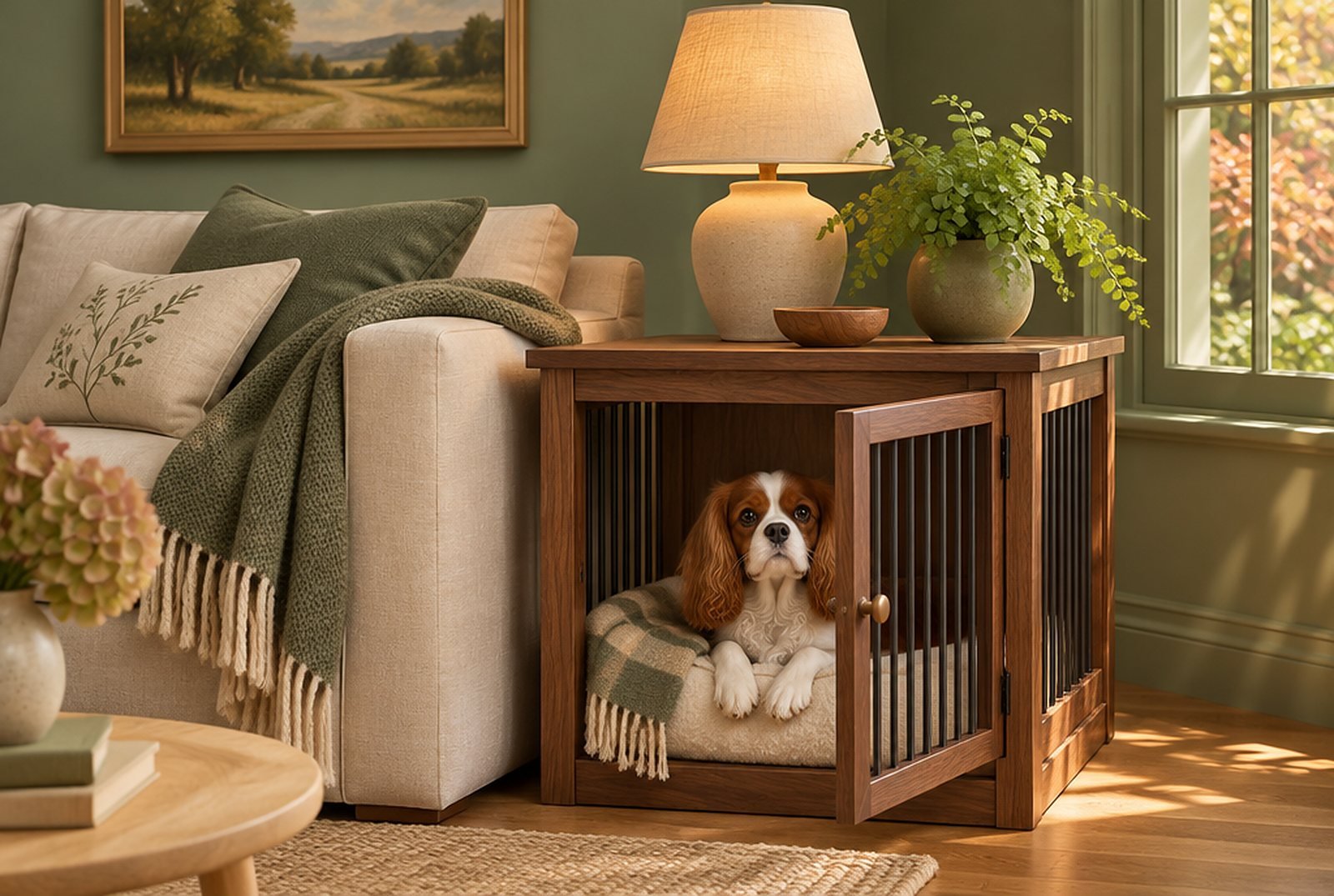
The best dog crate furniture ideas all work the same way: you replace a piece of furniture you already need, like an end table, a TV stand or a nightstand, with one that also gives your dog a den. You get one footprint instead of two, and your dog gets to rest in the room where people actually spend their time.
Start with the room your dog drifts toward in the evening. Then choose the type of furniture that suits that spot, and only then compare sizes and finishes. Do it in that order and you’ll end up with a crate your dog uses, not a handsome cabinet nobody sleeps in.
Below are room-by-room ideas, the placement rules we’d follow in any home, and a short list of what to check before you buy.
Where to put a dog crate before you pick the furniture
Placement matters more than looks. Dogs are social, and most settle faster when they can see or hear their people. A crate in a spare room at the end of the hall tends to get ignored, or worse, becomes the place a dog gets sent away to.
Use this checklist when you’re deciding where to put a dog crate:
- Near people, not in the traffic. Beside the sofa or at the edge of the room works. The path between the kitchen and the back door does not.
- Out of direct sun. A crate in front of a big window can get warm in the afternoon, even in winter.
- Away from heat and drafts. Keep it a few feet from radiators, floor vents, fireplaces and exterior doors that let cold air in every time they open.
- On a level floor. Doors and latches line up better, and the piece won’t rock when your dog turns around.
- With a little breathing room. Leave a few inches between any barred side and the wall so air can move.
- Where you can reach the door. If you’ll be letting your dog out from the couch, a door needs to face the couch.
A simple test: sit where you usually sit at night and look around. The spot where your dog already lies down within sight of you is often the right place for the crate.
Dog crate furniture ideas for the living room
The living room is where most people start, because it’s where the dog wants to be. Three layouts work especially well.
The end table beside the sofa
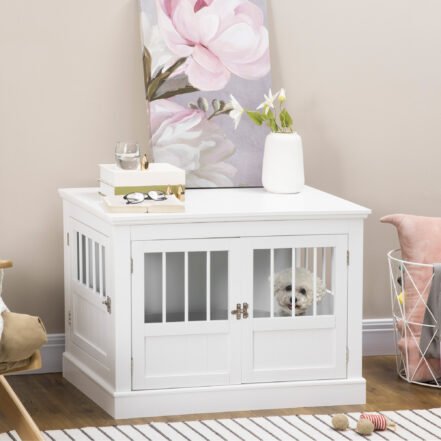
A dog crate end table is the most popular idea for a reason. It sits at arm’s height next to the couch, holds a lamp and a drink, and keeps your dog a foot or two from you while you watch TV. Browse dog crate end tables by your dog’s weight first, then by door layout.
Door placement is the detail people miss. If the crate sits to the left of the sofa, you want a door on the side that faces the cushions, not only on the front. For a small dog, the 30.75 in white end table with three magnetic doors handles this well: one long side opens fully, so a latch is always near the couch. It’s made for small dogs under 22 lb, with a 28.25 x 18.75 x 20 in interior.
For a bigger dog, look for end tables with a published interior or a stated weight limit, and check that the tabletop is big enough for the lamp you actually own.
The TV stand that hides a crate
If the sofa faces a long wall, a dog crate TV stand turns the biggest piece of furniture in the room into the den. Our dog crate TV stands include single-dog pieces and wide consoles with two compartments.
The 80 in gray double dog crate TV stand is a good example of what to look for. It has a divider wall and a front door for each compartment, sized for two medium or large dogs, and the base is raised 5.36 in so a robot vacuum fits underneath. The supplier rates the tabletop at 150 lb static load, which matters once a TV and a soundbar sit on top.
A few TV stand habits worth adopting:
- Run cables down the back, away from the crate doors, so nothing dangles where a dog can grab it.
- Don’t park a game console or cable box against the crate’s ventilation openings.
- Check your TV’s feet or stand against the tabletop depth before you order.
Two dogs, one console
Two dogs usually do better with their own rooms than with one shared space, even if they’re best friends. Double dog crate furniture gives each dog a compartment while keeping one tidy piece along the wall. Many have a removable divider, so a single large dog can use the full length later.
Bedroom ideas: the nightstand crate
A crate beside the bed is one of the most practical setups for a new puppy or a newly adopted dog. Your dog can hear you, you can hear when they stir, and you’ll know quickly when a puppy needs a middle-of-the-night potty trip.
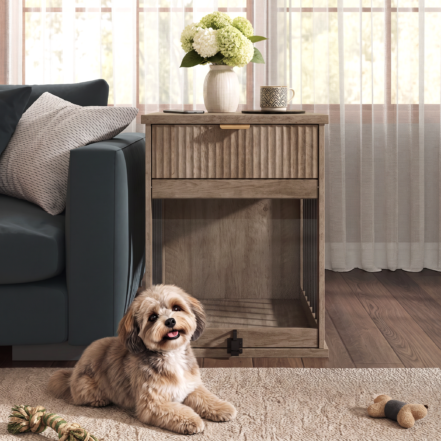
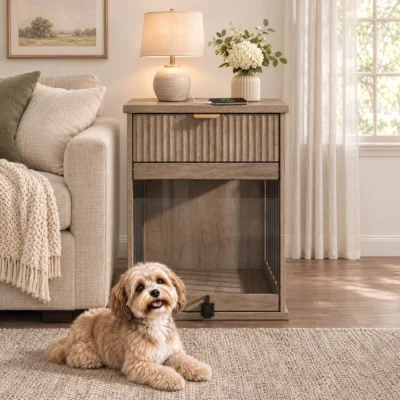
Nightstand crates are small and sit at bedside-table height. The gray oak nightstand crate with a charging station is listed for small to medium dogs and stands 27.6 in tall. It has 2 USB-A ports, 1 USB-C port and 2 AC outlets on top, a fluted drawer, and a tempered glass door that lifts and slides into the cabinet, so it fits a tight gap next to the bed.
If you go with a charging nightstand, keep phone cords on the tabletop rather than letting them hang down the front. And because the drawer and top take up part of the frame, compare your dog’s height with the usable crate space, not the overall height.
For small bedrooms, a sliding or lift-away door is worth a lot. It saves the floor space a swinging door needs, which is often the difference between fitting beside the bed or not fitting at all.
Entryway, mudroom and hallway ideas
An entryway crate makes sense if your dog already hangs out there: waiting by the door, coming in from walks with wet paws, watching for the mail. It also suits dogs who get a bit wound up in the busiest room of the house and like a quieter spot.
The sideboard by the front door
A long, low sideboard doubles as a drop zone for keys and mail. The walnut rattan sideboard crate is built on a rubber wood frame with tapered legs and four latched doors that can be set to open from either side. The woven rattan panels let air move through the den. It’s listed for small to medium dogs up to 40 lb, and its own listing says plainly that it’s not the right pick for a dog that chews or claws at doors. Take that seriously.
The empty corner
Most entryways and hallways have a corner nobody uses. A corner crate sits flush to both walls with no wasted space behind it. The walnut corner dog crate measures 31.5 in along each wall, has a locking fluted drawer above the den, and lists a cage rating of 150 lb with the tabletop rated to 100 lb. The supplier’s target size is dogs around 26 to 40 lb.
In a mudroom, think about cleanup first. A removable tray or a floor you can wipe matters more here than anywhere else in the house.
Home office ideas
If you work from home, a crate within sight of your desk gives your dog a settled spot during calls without shutting them in another room. Put it to the side of the desk rather than behind your chair, so you’re not rolling into the door every time you stand up.
Sliding doors shine in offices, where chairs, filing cabinets and printers crowd the floor. A barn door end table, for example, slides open along the front with no swing at all, and some designs add a drawer for leashes, poop bags and a few training treats you can reach between meetings.
One office-specific rule: keep cords for monitors, chargers and lamps well away from the crate, and never run an extension cord along its side.
Room-by-room cheat sheet
| Room | Furniture idea | Look for | Watch out for |
|---|---|---|---|
| Living room | End table beside the sofa | A door facing the couch, a top that fits your lamp | Blocking the walkway to the kitchen |
| Living room | TV stand or console | Stated tabletop load, raised base, divider for two dogs | Cables and warm electronics near the crate |
| Bedroom | Nightstand crate | Sliding or lift-away door, bedside height | Usable interior height under the drawer |
| Entryway | Sideboard or corner cabinet | Latched doors, a drop-zone top | Cold drafts from the front door |
| Mudroom | End table with a tray | Removable tray, wipe-clean surfaces | Wet paws on unsealed finishes |
| Home office | Barn door or sliding door end table | No door swing, a drawer for supplies | Cords and chair wheels near the door |
What to check before you buy a furniture style dog crate
A furniture crate has to pass two tests at once: it has to work as a crate, and it has to work as furniture. These are the checks that matter most.
Interior size, not exterior size
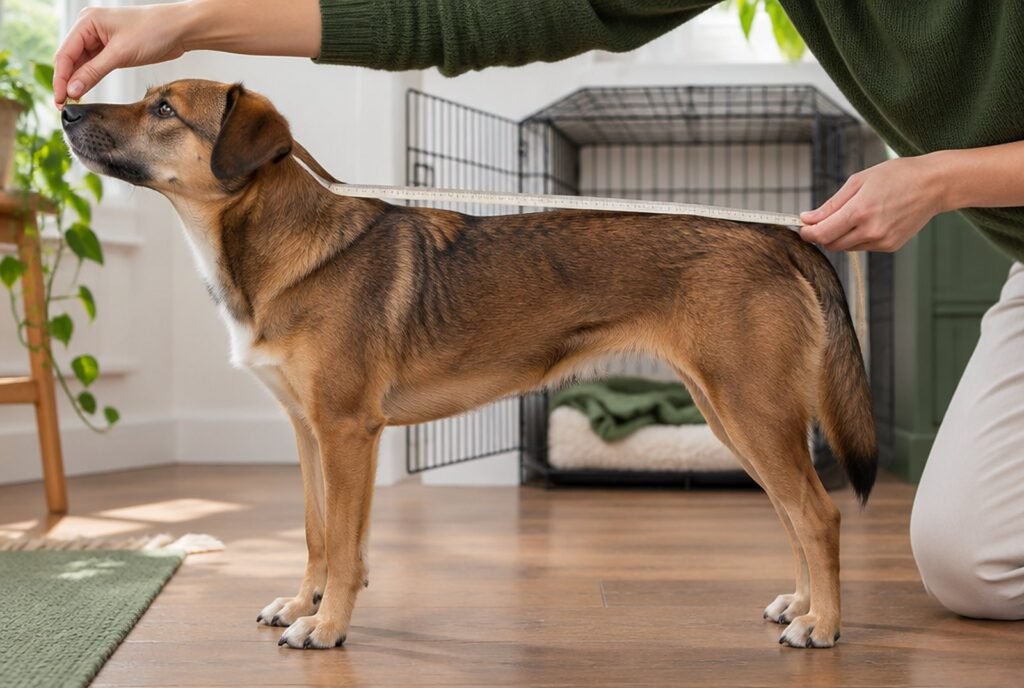
Panels, legs, drawers and tops all take up room, so the outside measurements of a furniture crate can be several inches bigger than the space your dog actually gets. Measure your dog standing, from the nose to the base of the tail and from the floor to the top of the head, then add about 4 in to each. Compare those numbers with the interior size when a listing gives it. Our dog crate size guide walks through the measuring, the Fit Finder narrows the options by your dog’s size, and our explainer on what size crate your dog needs covers puppies and dividers.
If a listing doesn’t publish interior dimensions, email your dog’s weight, breed and measurements to support@kennelkomforts.com before ordering. We’d rather help you check than have you guess.
Ventilation
Look for bars, mesh, rattan or slots on at least two sides. Solid-sided crates can feel cozy, but they need ventilation built in. If you like the idea of a darker den, our guide to dog crate covers explains how to get that feeling without trapping heat.
Top load
If the listing gives a tabletop rating, use it. A lamp and a book are light. A big TV, a soundbar and a stack of games are not. Leave a margin rather than loading the top right up to its stated limit.
Doors and latches
Count the doors and picture where the crate will stand. One front door is fine in an open spot. Against a wall or in a corner, a side door or a sliding door saves a lot of awkward reaching. Lockable latches help if your dog has figured out simple catches.
Finish and cleaning
Accidents happen, especially with puppies. A removable tray, a raised floor or wipe-clean panels make the difference between a quick cleanup and a stained cabinet.
Chewers and door testers
Be honest about your dog here. Wood, MDF and rattan look good in a room, but they aren’t built for a dog that chews panels or works at doors. If that’s your dog, a steel crate is the safer place to start, and our guide to escape-proof dog crates explains what to look for. You can move to furniture later, once the chewing phase is behind you.
Assembly and weight
Most pieces ship flat-packed and need assembly, and the larger ones are heavy. Plan on two people for long credenzas and double crates, and build the piece in the room where it will live.
Styling tips that keep it looking like furniture
- Match the room, not the dog. Pick a finish that ties in with your other wood tones or your trim color, so the crate reads as part of the room.
- Style the top like any side table. A lamp, a small tray and a book do more than a pile of leashes.
- Keep plants out of reach. Some common houseplants are toxic to dogs, and leaves that drop through the bars get eaten. Check any plant before it goes on top.
- Don’t drape fabric over the sides. Runners and throws that hang down block airflow and get pulled in.
- Anchor the spot with a washable rug. It looks intentional and catches the hair that drifts out of the door.
- Put the dog’s things in the drawers. If the piece has storage, that’s where treats, brushes and spare collars go.
Common mistakes with crate furniture
- Buying by exterior size. The cabinet fits the wall, but the dog can’t stand up inside.
- Choosing the room your dog never uses. Put the crate where the family spends time.
- Ignoring door direction. A crate pushed into a corner with its only door facing the wall gets used once.
- Overloading the top. Respect the stated rating and leave some margin.
- Using it as a time-out. The crate should be a good place to be. Never use it as punishment.
- Buying furniture for a heavy chewer. Start with steel and switch later.
Your next step
Pick the room first. Then measure the floor space you have, plus your dog’s standing length and height. With those numbers in hand, browse all of our dog crate furniture and narrow it down by your dog’s size. If two pieces both look close, send us the measurements and we’ll help you choose. Every order ships free to US addresses, and if anything arrives damaged or with a defect, our 90-day quality guarantee covers a refund or a replacement.